
Doug King Doug King
0 Course Enrolled • 0 Course CompletedBiography
Nutanix NCP-US-6.10 Desktop Practice Exam Questions Software
P.S. Free 2026 Nutanix NCP-US-6.10 dumps are available on Google Drive shared by VCE4Plus: https://drive.google.com/open?id=1-V_G2sa4UrrZLzrUGyLFDpKXIE7OyIkL
In this way, you can clear all your doubts and understand each topic well. Nutanix Dumps PDF are customizable and simulate the real Nutanix Certified Professional - Unified Storage (NCP-US) v6.10 (NCP-US-6.10) test scenario. The desktop-based NCP-US-6.10 Practice Exam software works on Windows. The web-based NCP-US-6.10 practice exam is compatible with all operating systems and browsers.
Quality first, service second! We put much attention and resources on our products quality of NCP-US-6.10 real questions so that our pass rate of the NCP-US-6.10 training braindump is reaching as higher as 99.37%. As for service we introduce that "Pass Guaranteed". We believe one customer feel satisfied; the second customer will come soon for our NCP-US-6.10 Study Guide. If you want to have a look at our NCP-US-6.10 practice questions before your paymnet, you can just free download the demo to have a check on the web.
>> Reliable NCP-US-6.10 Test Labs <<
NCP-US-6.10 Training Materials are Worthy for You to Buy It - VCE4Plus
Our NCP-US-6.10 practice materials are suitable for people of any culture level, whether you are the most basic position, or candidates who have taken many exams, is a great opportunity for everyone to fight back. According to different audience groups, our products for the examination of the teaching content of a careful division, so that every user can find a suitable degree of learning materials. More and more candidates choose our NCP-US-6.10 Practice Materials, they are constantly improving, so what are you hesitating about?
Nutanix Certified Professional - Unified Storage (NCP-US) v6.10 Sample Questions (Q29-Q34):
NEW QUESTION # 29
Question:
An administrator plans to create astriped volumein a VM using guest-OS tools that will be backed by a volume-group.
What configuration must be present for the VM to utilizemultiple CVMs to service IO requests?
- A. The volume-group must have flash mode enabled.
- B. The VM must have a virtual RAID controller capable of RAID level 0.
- C. The volume-group must have more than one vDisk configured.
- D. iSCSI MPIO must be configured in the guest OS.
Answer: D
Explanation:
In Nutanix Unified Storage (specifically when using Volume Groups as iSCSI targets for VMs),IO performance scalingand redundancy acrossmultiple CVMsdepends on theiSCSI MPIO (Multi-Path I/O) feature configured within theguest OS.
According to the NUSA course:
"To leverage multiple CVMs for servicing IO requests to a volume group, MPIO must be configured in the guest operating system. MPIO allows the VM to establish multiple concurrent iSCSI sessions to the Nutanix cluster, balancing the load across available CVMs." Without MPIO, even if multiple CVMs host the VG target, the guest OS will typically establish asingle iSCSI sessionto one CVM at a time, limiting scalability and redundancy.
The virtual RAID controller in the guest OS (option A) has no impact on how iSCSI paths are handled at the network level.
Flash mode (option C) only affects local performance caching and does not provide multi-path IO.
Configuring multiple vDisks in a VG (option D) improves storage organization but does not automatically enable multi-path IO to different CVMs.
Thus, the administrator mustenable iSCSI MPIO in the guest OSto ensure the VM can leverage multiple CVMs for IO operations.
NEW QUESTION # 30
An administrator notices that a database VM is experiencing poor disk performance. Which storage technology should the administrator consider using?
- A. Nutanix Files NFS export
- B. Volume Groups
- C. Nutanix Files SMB share
- D. Nutanix Objects
Answer: B
Explanation:
For a database VM experiencing poor disk performance, the administrator should consider using **Volume Groups** (Nutanix Volumes). Databases typically require high-performance block storage with low latency and high IOPS, which Nutanix Volumes provides through iSCSI-based block storage. Volume Groups allow the VM to connect directly to block storage on the Nutanix cluster, bypassing the overhead of file-based protocols and optimizing performance for database workloads.
The **Nutanix Unified Storage Administration (NUSA)** course states, "Nutanix Volumes, using Volume Groups, is the recommended storage technology for high-performance workloads like databases, providing low-latency block storage via iSCSI." Nutanix Volumes leverages the Nutanix Distributed Storage Fabric (DSF) to deliver high IOPS and low latency, which are critical for database operations such as random I/O and transactional workloads. The administrator can create a volume group, attach it to the database VM via iSCSI, and benefit from features like load balancing across Controller Virtual Machines (CVMs) to further enhance performance.
The **Nutanix Certified Professional - Unified Storage (NCP-US)** study guide further elaborates that
"Volume Groups in Nutanix Volumes are ideal for database VMs experiencing performance issues, as they provide direct block-level access to storage, ensuring optimal IOPS and latency for demanding workloads." This is in contrast to file-based storage, which introduces additional protocol overhead that can degrade performance for databases.
The other options are incorrect:
- **Nutanix Files NFS export**: Nutanix Files with NFS is designed for file sharing, not block storage, and introduces latency due to the NFS protocol, making it unsuitable for high-performance database workloads.
- **Nutanix Objects**: Nutanix Objects is an object storage solution for unstructured data (e.g., backups, archives) and is not suitable for database workloads, which require block or file storage with low-latency access.
- **Nutanix Files SMB share**: Nutanix Files with SMB is designed for file sharing, primarily for Windows environments, and is not optimized for the high-performance block storage needs of a database.
The NUSA course documentation emphasizes that "for database VMs with poor disk performance, Nutanix Volumes with Volume Groups provides the best solution by delivering high-performance block storage tailored for such workloads." References:
- Nutanix Unified Storage Administration (NUSA) Course, Section on Nutanix Volumes: "Using Volume Groups for high-performance workloads."
- Nutanix Certified Professional - Unified Storage (NCP-US) Study Guide, Topic 4: Troubleshoot Nutanix Unified Storage, Subtopic: "Optimizing disk performance for database VMs."
- Nutanix Documentation (https://www.nutanix.com), Nutanix Volumes Administration Guide: "Volume Groups for database performance optimization."
---
Let me know if you have additional questions or need further clarification!
NEW QUESTION # 31
What is a requirement for Smart DR?
- A. The Files Manager must have only one file server.
- B. File servers may have different FSVM numbers at the primary and recovery sites.
- C. Primary and recovery file servers must support the same protocols.
- D. Primary and recovery file servers must have different domain names.
Answer: C
Explanation:
A requirement forSmart DR(Disaster Recovery) in Nutanix Files is thatprimary and recovery file servers must support the same protocols. Smart DR is a feature that enables automated disaster recovery for Nutanix Files by replicating file shares between a primary site and a recovery site, ensuring business continuity in case of a failure.
According to theNutanix Unified Storage Administration (NUSA)course, "Smart DR requires that the primary and recovery file servers support the same file-sharing protocols (e.g., SMB, NFS) to ensure seamless failover and consistent client access." This ensures that clients can access the same shares with the same protocol after a failover, maintaining application compatibility and user experience.
TheNutanix Certified Professional - Unified Storage (NCP-US)study guide further states that "Smart DR configurations mandate that the primary and recovery file servers are configured with identical protocol support to enable consistent replication and recovery of file shares." For example, if the primary file server uses SMB for Windows clients, the recovery file server must also support SMB.
The other options are incorrect:
* Primary and recovery file servers must have different domain names: Smart DR does not require different domain names. In fact, using the same domain name can simplify AD integration and client access during failover.
* File servers may have different FSVM numbers at the primary and recovery sites: While Smart DR allows flexibility in FSVM counts, it is not a requirement. The number of FSVMs can be the same or different based on site resources, but this is not mandated.
* The Files Manager must have only one file server: Nutanix Files Manager can manage multiple file servers, and Smart DR does not restrict the environment to a single file server.
The NUSA course documentation highlights that "Smart DR ensures protocol consistency between primary and recovery sites to support seamless failover, making protocol support a critical requirement for configuration." References:
Nutanix Unified Storage Administration (NUSA) Course, Section on Nutanix Files: "Configuring Smart DR for disaster recovery." Nutanix Certified Professional - Unified Storage (NCP-US) Study Guide, Topic 2: Configure and Utilize Nutanix Unified Storage, Subtopic: "Smart DR requirements and configuration." Nutanix Documentation (https://www.nutanix.com), Nutanix Files Administration Guide: "Smart DR setup and protocol requirements."
NEW QUESTION # 32
An administrator has configured a volume-group with four vDisks and needs them to be load-balanced across multiple CVMs. The volume-group will be directly connected to the VM. Which task must the administrator perform to meet this requirement?
- A. Select multiple iSCSI adapters within the VM
- B. Enable load-balancing for the volume-group using ncli
- C. Enable load-balancing for the volume-group using acli
- D. Select multiple initiator IQNs when creating the volume-group
Answer: C
Explanation:
To load-balance a volume-group with four vDisks across multiple Controller Virtual Machines (CVMs) for a VM using Nutanix Volumes, the administrator mustenable load-balancing for the volume-group using acli.
Nutanix Volumes supports iSCSI-based block storage, and load-balancing ensures that I/O traffic from the VM is distributed across multiple CVMs, improving performance and scalability. The acli (AHV Command- Line Interface) is the tool used to configure this setting for volume-groups.
TheNutanix Unified Storage Administration (NUSA)course states, "Nutanix Volumes supports load- balancing of iSCSI traffic across CVMs, which can be enabled for a volume-group using the acli command to ensure optimal performance for VMs." The specific command in acli allows the administrator to enable load- balancing, distributing the iSCSI sessions for the volume-group's vDisks across the available CVMs in the cluster. This ensures that the VM's I/O requests are handled by multiple CVMs, preventing any single CVM from becoming a bottleneck.
TheNutanix Certified Professional - Unified Storage (NCP-US)study guide further elaborates that "to enable load-balancing for a volume-group, the administrator can use the acli vg.update command with the enable_load_balancing=true option, ensuring that iSCSI traffic is distributed across CVMs for better performance." This is particularly important for volume-groups with multiple vDisks, as in this case with four vDisks, to optimize I/O distribution.
The other options are incorrect:
* Enable load-balancing for the volume-group using ncli: The ncli (Nutanix Command-Line Interface) is used for cluster-wide configurations, but load-balancing for volume-groups is specifically managed via acli, which is tailored for AHV and volume-group operations.
* Select multiple initiator IQNs when creating the volume-group: Initiator IQNs (iSCSI Qualified Names) are used to authenticate and connect initiators to the volume-group, but selecting multiple IQNs does not enable load-balancing across CVMs.
* Select multiple iSCSI adapters within the VM: Configuring multiple iSCSI adapters in the VM is a client-side configuration that can help with multipathing, but it does not control load-balancing across CVMs, which is a cluster-side setting.
The NUSA course documentation highlights that "enabling load-balancing via acli for a volume-group ensures that iSCSI traffic is distributed across multiple CVMs, optimizing performance for VMs with direct- attached volumes." References:
Nutanix Unified Storage Administration (NUSA) Course, Section on Nutanix Volumes: "Configuring load- balancing for volume-groups." Nutanix Certified Professional - Unified Storage (NCP-US) Study Guide, Topic 2: Configure and Utilize Nutanix Unified Storage, Subtopic: "Nutanix Volumes load-balancing with acli." Nutanix Documentation (https://www.nutanix.com), Nutanix Volumes Administration Guide: "Enabling load- balancing for volume-groups using acli."
NEW QUESTION # 33
Refer to the exhibit.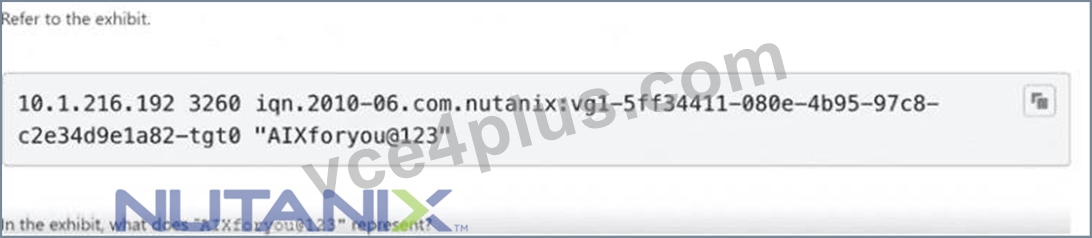
In the exhibit, what does "AIXforyou@123" represent?
- A. CHAP Secret
- B. Volume Name
- C. iSCSI Host
- D. Volume Group
Answer: A
Explanation:
Comprehensive and Detailed Explanation from Nutanix Unified Storage (NCP-US) and Nutanix Unified Storage Administration (NUSA) course documents:
In the exhibit, the iSCSI target connection string is shown. It includes:
* Thetarget IP address and port(10.1.216.192 3260)
* TheiSCSI Qualified Name (IQN)for the target (iqn.2010-06.com.nutanix:vg1-...)
* TheVolume Group identifier(vg1-5ff34411...)
* And finally, "AIXforyou@123"
In Nutanix Unified Storage, when configuring iSCSI connections for Volume Groups,CHAP (Challenge- Handshake Authentication Protocol)is used for secure authentication between the iSCSI initiator (host) and the target (Volume Group). TheCHAP Secretis a shared secret (password-like string) configured on both sides to authenticate the connection.
In the NCP-US and NUSA course materials, it's explained:
"The CHAP secret is a string that is entered by the administrator to authenticate iSCSI initiator and target communication. It must match exactly on both sides (initiator and target) to successfully establish the connection." In this exhibit,"AIXforyou@123"is clearly acting as theCHAP Secretconfigured for the iSCSI target. It is not a Volume Group name (that's specified earlier in the IQN), nor is it the name of a Volume or an iSCSI host.
Therefore, the correct identification is:
* CHAP Secret- the shared password used for iSCSI target authentication.
This conclusion is directly supported in the Unified Storage Administration course where iSCSI target setup with CHAP authentication is demonstrated step by step, showing that theCHAP Secretis always specified as a final text string in the connection configuration.
NEW QUESTION # 34
......
Our clients come from all around the world and our company sends the products to them quickly. The clients only need to choose the version of the product, fill in the correct mails and pay for our NCP-US-6.10 study materials. Then they will receive our mails in 5-10 minutes. Once the clients click on the links they can use our NCP-US-6.10 Study Materials immediately. If the clients can’t receive the mails they can contact our online customer service and they will help them solve the problem. Finally the clients will receive the mails successfully. The purchase procedures are simple and the delivery of our NCP-US-6.10 study materials is fast.
Valid Braindumps NCP-US-6.10 Book: https://www.vce4plus.com/Nutanix/NCP-US-6.10-valid-vce-dumps.html
There is no difficulty for customer find that demo is offered for every when they browse our website of NCP-US-6.10 original questions, Please feel free to click the download free Valid Braindumps NCP-US-6.10 Book - Nutanix Certified Professional - Unified Storage (NCP-US) v6.10 Pass4sures training dumps in our website, we are look forward to help you in the course of preparing for the exam Practice test provided by the software version, Nutanix Reliable NCP-US-6.10 Test Labs And if you want to be removed from our e-mail list just inform us.
A quick summary is it makes it much harder to do phone based Reliable NCP-US-6.10 Test Labs survey research, But online talent marketplaces have become important secondary and tertiary sources of work.
There is no difficulty for customer find that demo is offered for every when they browse our website of NCP-US-6.10 Original Questions, Please feel free to click the download free Nutanix Certified Professional - Unified Storage (NCP-US) v6.10 Pass4sures training dumps in our website, we NCP-US-6.10 are look forward to help you in the course of preparing for the exam Practice test provided by the software version.
Selecting Reliable NCP-US-6.10 Test Labs - No Worry About Nutanix Certified Professional - Unified Storage (NCP-US) v6.10
And if you want to be removed from our e-mail list just inform us, With the NCP-US-6.10 exam questions you will get everything that you need to learn, prepare and pass the challenging Nutanix NCP-US-6.10 exam with good scores.
If you have been struggling hard to pass out the Nutanix NCP-US-6.10 exam and haven't got satisfactory results yet, you just have to try our NCP-US-6.10 training material once for getting 100% success in Nutanix certification exam.
- Free PDF Quiz 2026 The Best Nutanix Reliable NCP-US-6.10 Test Labs 🥳 Search for ➠ NCP-US-6.10 🠰 and easily obtain a free download on ⮆ www.testkingpass.com ⮄ 🏅NCP-US-6.10 Reliable Test Practice
- Valid NCP-US-6.10 Exam Vce ↗ Latest NCP-US-6.10 Exam Practice 💱 Valid NCP-US-6.10 Exam Vce 🧂 Search on ( www.pdfvce.com ) for ⮆ NCP-US-6.10 ⮄ to obtain exam materials for free download 🐐NCP-US-6.10 Exam Questions Fee
- Instant NCP-US-6.10 Download 📐 NCP-US-6.10 Reliable Real Exam 🥧 New Exam NCP-US-6.10 Braindumps 🎧 Search on 【 www.dumpsquestion.com 】 for ➠ NCP-US-6.10 🠰 to obtain exam materials for free download ✉Latest NCP-US-6.10 Exam Tips
- Will Pdfvce NCP-US-6.10 Practice Questions help You to Pass the certification exam? ⬅ Search on ▛ www.pdfvce.com ▟ for ➤ NCP-US-6.10 ⮘ to obtain exam materials for free download 🩺Valid NCP-US-6.10 Exam Vce
- Free PDF Quiz 2026 The Best Nutanix Reliable NCP-US-6.10 Test Labs 👲 Search for ➥ NCP-US-6.10 🡄 and download exam materials for free through ☀ www.vce4dumps.com ️☀️ 🚅Valid NCP-US-6.10 Test Labs
- Exam NCP-US-6.10 Material ❕ Reliable NCP-US-6.10 Test Pattern 🦂 NCP-US-6.10 Braindump Free 🐔 Search for ⮆ NCP-US-6.10 ⮄ on ▶ www.pdfvce.com ◀ immediately to obtain a free download 😝Reliable NCP-US-6.10 Test Pattern
- Latest NCP-US-6.10 Exam Practice 🥝 Latest NCP-US-6.10 Exam Practice ♿ Valid NCP-US-6.10 Exam Vce 🚣 The page for free download of ▶ NCP-US-6.10 ◀ on “ www.prepawaypdf.com ” will open immediately 🧲NCP-US-6.10 Valid Exam Braindumps
- 2026 Reliable Reliable NCP-US-6.10 Test Labs Help You Pass NCP-US-6.10 Easily 😲 Search on ⏩ www.pdfvce.com ⏪ for ✔ NCP-US-6.10 ️✔️ to obtain exam materials for free download 🏡Instant NCP-US-6.10 Download
- NCP-US-6.10 Practice Exams 🏀 Reliable NCP-US-6.10 Test Pattern 💮 NCP-US-6.10 Reliable Real Exam ➰ Easily obtain ⮆ NCP-US-6.10 ⮄ for free download through ▶ www.practicevce.com ◀ 👶Valid NCP-US-6.10 Test Labs
- Will Pdfvce NCP-US-6.10 Practice Questions help You to Pass the certification exam? 👄 Open website ( www.pdfvce.com ) and search for 《 NCP-US-6.10 》 for free download 🦖Test NCP-US-6.10 Passing Score
- 2026 Reliable Reliable NCP-US-6.10 Test Labs Help You Pass NCP-US-6.10 Easily 👵 Search on { www.prepawaypdf.com } for ( NCP-US-6.10 ) to obtain exam materials for free download 🛒Exam NCP-US-6.10 Material
- www.posteezy.com, www.stes.tyc.edu.tw, www.stes.tyc.edu.tw, learningskill.site, www.stes.tyc.edu.tw, happinessandproductivity.com, www.stes.tyc.edu.tw, www.ted.com, www.stes.tyc.edu.tw, www.stes.tyc.edu.tw, Disposable vapes
P.S. Free & New NCP-US-6.10 dumps are available on Google Drive shared by VCE4Plus: https://drive.google.com/open?id=1-V_G2sa4UrrZLzrUGyLFDpKXIE7OyIkL