
Liam Stewart Liam Stewart
0 Course Enrolled • 0 Course CompletedBiography
NCP-MCI-6.10 Practice Exams Free | Test NCP-MCI-6.10 Sample Questions
BONUS!!! Download part of PrepAwayETE NCP-MCI-6.10 dumps for free: https://drive.google.com/open?id=1safTnPbEPpDSBQVOav-Szu5fBadgeVRq
PrepAwayETE is obliged to give you three months of free update checks to ensure the validity and accuracy of the Nutanix Certified Professional - Multicloud Infrastructure (NCP-MCI v6.10) (NCP-MCI-6.10) exam dumps. We also offer you a 100% money-back guarantee, in the very rare case of failure or unsatisfactory results. This puts your mind at ease when you are Nutanix Certified Professional - Multicloud Infrastructure (NCP-MCI v6.10) (NCP-MCI-6.10) exam preparing with us.
Nutanix NCP-MCI-6.10 Exam Syllabus Topics:
| Topic | Details |
|---|---|
| Topic 1 |
|
| Topic 2 |
|
| Topic 3 |
|
| Topic 4 |
|
| Topic 5 |
|
>> NCP-MCI-6.10 Practice Exams Free <<
Valid Nutanix Certified Professional - Multicloud Infrastructure (NCP-MCI v6.10) Exam Dumps 100% Guarantee Pass Nutanix Certified Professional - Multicloud Infrastructure (NCP-MCI v6.10) Exam
We would like to benefit our customers from different countries who decide to choose our NCP-MCI-6.10 study guide in the long run, so we cooperation with the leading experts in the field to renew and update our NCP-MCI-6.10 learning materials. Our leading experts aim to provide you the newest information in this field in order to help you to keep pace with the times and fill your knowledge gap. As long as you bought our NCP-MCI-6.10 Practice Engine, you are bound to pass the NCP-MCI-6.10 exam for sure.
Nutanix Certified Professional - Multicloud Infrastructure (NCP-MCI v6.10) Sample Questions (Q101-Q106):
NEW QUESTION # 101
An administrator is experiencingstorage performance issueson aWindows Server 2019 VMwith the following configuration:
* vCPU: 1
* VRAM: 8 GB
* vSCSI: VirtIO SCSI Controller
* vDisk: 2 (100 GB, 250 GB)
* vNIC: VirtIO Fast Ethernet
TheAHV cluster is healthy, andother Windows VMs are performing well.
Which configuration change should be reviewed to enhance VM performance?
- A. Increase the VM's number of vCPUs.
- B. Enable Balance-TCP on bridge (br0).
- C. Add a second virtual storage controller (vSCSI).
- D. Increase Controller VM (CVM) resources.
Answer: A
Explanation:
A single vCPU is likely causing a bottleneck, limiting the VM's ability to process I/O requests efficiently.
* Option D (Increase the VM's number of vCPUs) is correct:
* Windowsrequires sufficient CPU resourcesto handle disk and network operations.
* Adding more vCPUs allows the VM to process more I/O operations simultaneously, improving performance.
* Option A is incorrect:
* AdditionalvSCSI controllers are only useful for very high disk I/O workloads.
* Option B is incorrect:
* Balance-TCP applies to network traffic, not storage performance.
* Option C is incorrect:
* CVM resources do not directly affect individual VM performance.
References:
* Nutanix AHV Performance Tuning Guide
* Nutanix KB#Optimizing Windows VM Performance on AHV
NEW QUESTION # 102
An administrator is experiencing performance issues within a VM and believes that more vCPU should be added to the specific VM. The cluster as a whole appears to be performing well.
Which two metrics should be analyzed to determine if adding more vCPUs is warranted? (Choose two.)
- A. Host Memory Swap Out Rate
- B. Host CPU usage
- C. VM CPU Ready Time
- D. VM CPU Usage
Answer: C,D
Explanation:
The Nutanix ECA course provides guidance on performance monitoring and troubleshooting for VMs, including metrics to analyze when determining whether additional vCPUs are needed. The scenario involves a VM experiencing performance issues, with the cluster performing well overall, suggesting the issue is VM- specific.
Extract from Nutanix Enterprise Cloud Administration (ECA) Course Documents:
* Module: Performance Monitoring, Section: VM Performance Metrics"To determine if a VM requires additional vCPUs, analyze VM CPU Usage and VM CPU Ready Time. High CPU Usage indicates the VM is under heavy load, while high CPU Ready Time suggests the VM is waiting for CPU resources, both justifying additional vCPUs."
* Module: Troubleshooting, Section: VM Performance Issues"When a VM experiences performance issues, VM CPU Usage and VM CPU Ready Time are critical metrics. CPU Usage shows demand, while CPU Ready Time indicates contention or scheduling delays, helping determine if more vCPUs are warranted." Explanation of Options:
* A. VM CPU UsageThis is correct. VM CPU Usage measures the percentage of CPU resources the VM is consuming. High CPU Usage (e.g., consistently above 80-90%) indicates that the VM is under heavy load and may benefit from additional vCPUs to handle the workload. The ECA course emphasizes:"VM CPU Usage is the primary metric to assess whether a VM's CPU allocation is sufficient for its workload."
* B. VM CPU Ready TimeThis is correct. VM CPU Ready Time measures the time a VM is ready to run but waiting for CPU resources from the hypervisor due to contention or oversubscription. High CPU Ready Time (e.g., above 5-10%) suggests that the VM is not getting enough CPU cycles, and adding vCPUs could alleviate the issue. The ECA course notes:"High VM CPU Ready Time indicates CPU contention, often resolved by adding vCPUs or optimizing resource allocation."
* C. Host Memory Swap Out RateThis is incorrect. Host Memory Swap Out Rate indicates memory pressure on the host, causing memory pages to be swapped to disk. While this can affect VM performance, it is unrelated to CPU performance and does not justify adding vCPUs. The ECA course states:"Host Memory Swap Out Rate is relevant for memory-related issues, not CPU allocation decisions."
* D. Host CPU UsageThis is incorrect. Host CPU Usage measures the overall CPU utilization of the host, not the specific VM. Since the cluster is performing well overall, high Host CPU Usage is unlikely, and it does not directly indicate whether the VM needs more vCPUs. The ECA course clarifies:"Host CPU Usage is a cluster-wide metric and less relevant for diagnosing VM-specific CPU performance issues." Additional Context from ECA:
* Performance Monitoring Tools: In Prism Element or Prism Central, VM CPU Usage and CPU Ready Time can be monitored underVM > Monitoror through dashboards. These metrics provide insight into the VM's CPU demand and contention.
* Adding vCPUs: The ECA course advises caution when adding vCPUs, as over-allocation can increase CPU Ready Time due to scheduling overhead. However, if both CPU Usage and Ready Time are high, adding vCPUs is justified.
Supporting Reference from Web Results:
The Nutanix Bible (https://www.nutanix.com/go/the-nutanix-bible) supports:"For VM performance issues, analyze VM CPU Usage and CPU Ready Time to determine if additional vCPUs are needed, as these metrics directly indicate CPU demand and contention."
NEW QUESTION # 103
An administrator is tasked with ensuring the resiliency of Tier-1 workloads. As such, the administrator creates a Protection Policy with a crash-consistent snapshot period that meets RPO while maintaining 10 recovery points locally and 5 at DR location.
Since it is difficult to quantify how long a DR event will last, management wants the Tier-1 workloads to always have 10 recovery points locally.
How can this be achieved logically and most efficiently?
- A. Post DR, recreate the Protection Policy with new/updated values.
- B. Enable Reverse Retention within the Protection Policy Schedule.
- C. Change retentions within the Protection Policy to be 10 at both locations and Save Schedule.
- D. Utilize a script that executes an API to take the requisite number of recovery points post- DR.
Answer: B
NEW QUESTION # 104
Refer to the Exhibit: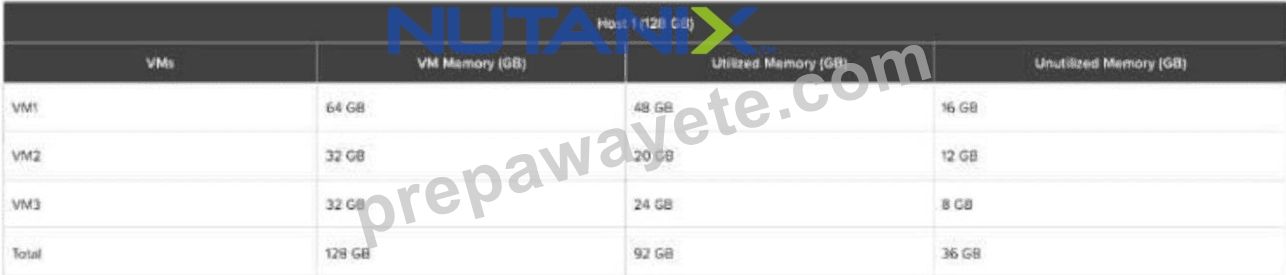
An administrator needs to create two virtual machines: VM4 and VM5 that leverage the memory over-commit feature.
Once VM4 is created and running, the administrator notices that it uses only 28GB of RAM.
What will be the maximum RAM that can be allocated to VM5 so that it can be powered on?
- A. 32GB
- B. 4GB
- C. 16GB
- D. 8GB
Answer: D
Explanation:
Understanding the Exhibit & Memory Allocation
* Thehost has 128GB of physical RAM.
* Thecurrent memory allocationacrossthree VMs (VM1, VM2, VM3) is 128GB, but only92GB is actually utilized.
* This means there is36GB of unutilized memory available for allocation.
Step-by-Step Breakdown
* Existing Memory Usage Before Adding VM4
* Total Physical RAM:128GB
* Used by running VMs (VM1, VM2, VM3):92GB
* Unutilized Memory Available:36GB
* After Creating and Running VM4
* VM4 is allocatedmemory but only utilizes 28GB.
* The table does not show VM4's allocated RAM, but assuming it was given a reasonable allocation, it must have been taken from the36GB unutilized memory pool.
* IfVM4 uses 28GB, theremaining unutilized memory is now (36GB - 28GB) = 8GB.
* Maximum Memory Allocation for VM5
* Sinceonly 8GB remains unutilized, the maximum memory VM5 can be allocated while still allowing it to power on is8GB.
Evaluating the Answer Choices
* (A) 4GB#(Incorrect)
* More memory (8GB) is available, so limiting to 4GB is unnecessary.
* (B) 8GB#(Correct)
* Theremaining unutilized memory after VM4 is 8GB, so VM5 can be allocated up to8GBwhile ensuring it can power on.
* (C) 16GB#(Incorrect)
* Only8GB is left, so 16GB isnot possible.
* (D) 32GB#(Incorrect)
* There isnot enough unutilized memoryto allocate 32GB.
Key Concept: Nutanix Memory Overcommit
* Nutanix AHV supportsmemory overcommit, meaning VMs can be allocated more memory than physically available usingmemory ballooning and swapping.
* However,to power on VM5 without impacting performance, it must fit within the available unutilized memory, which is8GB.
NEW QUESTION # 105
In Prism Element, how many nodes can be placed into maintenance mode at one time on 12-node FT2 cluster?
- A. 0
- B. 1
- C. 2
- D. 3
Answer: B
Explanation:
In a 12-node FT2 cluster, onlyonenode can be placed into maintenance mode at a time. This ensures that the cluster maintains data redundancy and protection (FT2 indicates 2-failure tolerance).
From theNutanix Enterprise Cloud Administration (ECA)course materials:
"For FT2 clusters, a maximum of one node can be placed in maintenance mode at a time to ensure the cluster' s ability to tolerate failures and maintain quorum."
NEW QUESTION # 106
......
The pass rate for NCP-MCI-6.10 study guide materials is 99%, and if you choose us, we can ensure you that you will pass the exam successfully. You can also enjoy free update for one year if you buy NCP-MCI-6.10 study materials from us, and the update version will be sent to your email automatically, therefore in the following year, you can get the free update version without spending money. Besides, our technicians will check the website constantly to ensure you have a good online shopping environment while buying NCP-MCI-6.10 Exam Dumps from us.
Test NCP-MCI-6.10 Sample Questions: https://www.prepawayete.com/Nutanix/NCP-MCI-6.10-practice-exam-dumps.html
- Use Real Nutanix NCP-MCI-6.10Exam Dumps 2025 100% Guaranteed Success 🌌 Go to website “ www.dumps4pdf.com ” open and search for ☀ NCP-MCI-6.10 ️☀️ to download for free 🟧New NCP-MCI-6.10 Cram Materials
- NCP-MCI-6.10 Valid Exam Camp 🙈 NCP-MCI-6.10 Latest Exam Practice 🍺 NCP-MCI-6.10 Latest Exam Practice 🗳 Download 【 NCP-MCI-6.10 】 for free by simply searching on ⇛ www.pdfvce.com ⇚ 👌Reliable NCP-MCI-6.10 Exam Prep
- NCP-MCI-6.10 Practice Exams Free - How to Prepare for Nutanix NCP-MCI-6.10 Exam 🎀 Open [ www.exams4collection.com ] and search for ☀ NCP-MCI-6.10 ️☀️ to download exam materials for free 🥞NCP-MCI-6.10 Exam Topics Pdf
- Reliable NCP-MCI-6.10 Dumps Ppt 🎅 NCP-MCI-6.10 Valid Exam Camp 🅾 NCP-MCI-6.10 Valid Exam Camp ❓ Search for ➤ NCP-MCI-6.10 ⮘ on ⮆ www.pdfvce.com ⮄ immediately to obtain a free download 🅱New NCP-MCI-6.10 Cram Materials
- NCP-MCI-6.10 Prep Guide 🩲 NCP-MCI-6.10 Dumps Guide 🚉 NCP-MCI-6.10 New Practice Questions 🥋 Search for ➠ NCP-MCI-6.10 🠰 and easily obtain a free download on { www.itcerttest.com } 🧿NCP-MCI-6.10 Prep Guide
- Free PDF Quiz 2025 NCP-MCI-6.10: Fantastic Nutanix Certified Professional - Multicloud Infrastructure (NCP-MCI v6.10) Practice Exams Free 🕘 Go to website ⏩ www.pdfvce.com ⏪ open and search for ⏩ NCP-MCI-6.10 ⏪ to download for free 🛌NCP-MCI-6.10 Prep Guide
- Reliable NCP-MCI-6.10 Dumps Ppt 🟣 NCP-MCI-6.10 Study Dumps 🐴 NCP-MCI-6.10 Exam Topics Pdf ☮ “ www.real4dumps.com ” is best website to obtain ( NCP-MCI-6.10 ) for free download 🏸NCP-MCI-6.10 100% Correct Answers
- NCP-MCI-6.10 Exam Learning 🤲 NCP-MCI-6.10 Valid Exam Camp 👪 Reliable NCP-MCI-6.10 Dumps Ppt 😛 Search on 「 www.pdfvce.com 」 for ⏩ NCP-MCI-6.10 ⏪ to obtain exam materials for free download 🖊Practice NCP-MCI-6.10 Mock
- NCP-MCI-6.10 Study Dumps 👶 NCP-MCI-6.10 Study Dumps 🏕 NCP-MCI-6.10 Exam Topics Pdf ↪ Search for ▶ NCP-MCI-6.10 ◀ and obtain a free download on ( www.exams4collection.com ) 🔑NCP-MCI-6.10 Prep Guide
- NCP-MCI-6.10 Practice Exams Free - How to Prepare for Nutanix NCP-MCI-6.10 Exam 🌯 Open website ⇛ www.pdfvce.com ⇚ and search for ⏩ NCP-MCI-6.10 ⏪ for free download 🤧New NCP-MCI-6.10 Cram Materials
- NCP-MCI-6.10 Study Guide Pdf 🕶 NCP-MCI-6.10 100% Correct Answers 🦊 Reliable NCP-MCI-6.10 Dumps Ppt 📑 Open ➥ www.passcollection.com 🡄 and search for ➠ NCP-MCI-6.10 🠰 to download exam materials for free 🦡New NCP-MCI-6.10 Cram Materials
- www.stes.tyc.edu.tw, 1.gdsfjd.net, shortcourses.russellcollege.edu.au, yxy99.top, www.stes.tyc.edu.tw, www.stes.tyc.edu.tw, bobking269.techionblog.com, shortcourses.russellcollege.edu.au, afotouh.com, edu.globalfinx.in
P.S. Free 2025 Nutanix NCP-MCI-6.10 dumps are available on Google Drive shared by PrepAwayETE: https://drive.google.com/open?id=1safTnPbEPpDSBQVOav-Szu5fBadgeVRq